
Save 2+ Hours Per Day
No more repetitive post-op calls or printed instructions. Follow-up runs on autopilot while you focus on surgeries.
Maximize transplant success rates with precise post-op instructions. PostCare sends automated WhatsApp messages with washing instructions, growth timelines, and appointment reminders — improving compliance by 85% and patient satisfaction.
PostCare for hair transplant clinics automates post-op messaging via WhatsApp with day-by-day graft care instructions, washing protocols, and growth timeline updates. AI monitors recovery photos and flags complications for FUE and FUT procedures.
Based on PostCare customer data
Pre-built message sequences for every service
No more repetitive post-op calls or printed instructions. Follow-up runs on autopilot while you focus on surgeries.
Automated messages with washing, sleeping instructions, and hair growth timelines.
AI flags infections, bleeding, or problematic graft sites.
85% post-op care compliance = better hair growth and patient satisfaction.
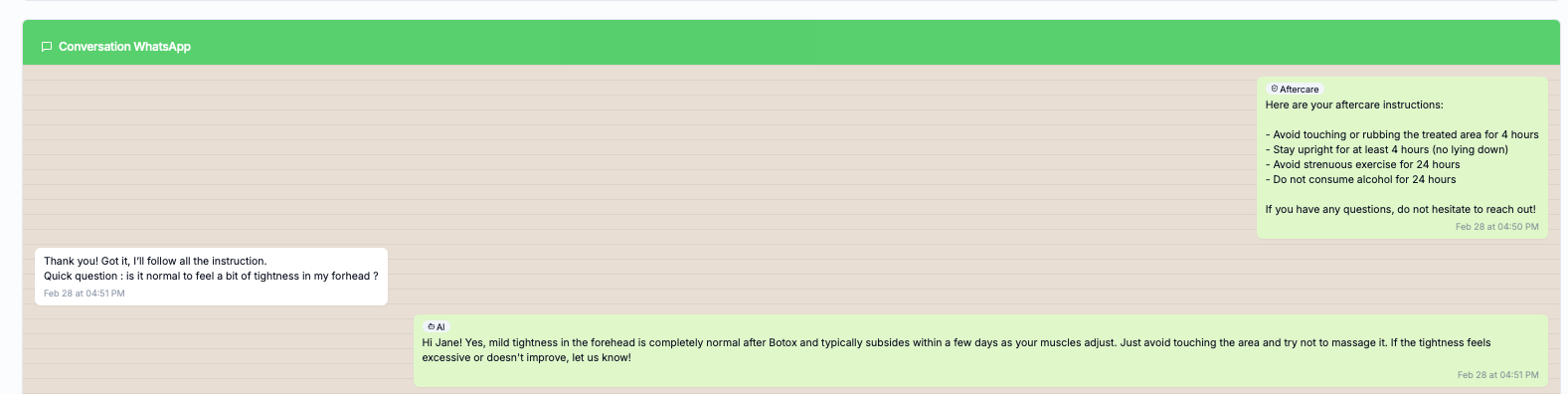
Select from aftercare protocols for FUE, FUT, DHI, PRP therapy, and beard transplants. Each protocol includes timed messages aligned with the actual recovery and growth timeline — from the first night through the 12-month growth cycle.
Add your patient to the protocol right after the procedure. PostCare records the surgery date and schedules every post-op message automatically — covering the critical first week through the full growth timeline.
Your patient receives WhatsApp messages at every critical milestone — a sleeping position reminder on night 1, first wash instructions on day 3, a graft shedding reassurance at week 2, and growth progress check-ins at months 3, 6, and 12. If they report swelling, bleeding, or graft concerns, AI flags it for your team immediately.
Graft survival in the first 7 days depends heavily on patient behavior — how they sleep, when they first wash, and whether they touch or dislodge grafts accidentally. PostCare sends a message on night 1 about elevated sleeping at 45 degrees, a day-2 reminder to avoid touching the recipient area, and detailed first-wash instructions on day 3 with water pressure and temperature guidance. Clinics using PostCare report significantly fewer cases of graft dislodgment caused by patient error during the critical early recovery window.
The washing schedule after a hair transplant is uniquely precise and confusing for patients. They need to start gentle washing on day 3-5, use specific patting motions rather than rubbing, and gradually transition to normal washing over 2-3 weeks. PostCare delivers step-by-step washing instructions at each phase — soaking the grafts with a spray bottle on day 3, introducing gentle lathering on day 7, and clearing patients for normal shampooing at week 3. Patients who follow these timed instructions consistently show better graft retention and fewer infections.
The growth timeline after a hair transplant is emotionally challenging for patients. Shock loss at weeks 2-4 causes significant anxiety when transplanted hairs fall out — a completely normal part of the process. PostCare sends a proactive message at the 2-week mark explaining that shedding is expected, new growth begins at months 3-4, and full results take 12-18 months. Monthly check-in messages through the growth cycle keep patients reassured and engaged. This sustained communication reduces anxious calls and builds confidence in your clinic's results.
Yes. Hair transplant protocols in PostCare span the entire recovery and growth cycle. Messages cover the critical first week of graft survival, the shedding phase at weeks 2-4, early growth at months 3-4, and progress check-ins at months 6, 9, and 12. You can customize the timing and content to match your clinical approach.
PostCare sends a preemptive message before shock loss typically begins, explaining that transplanted hairs will shed at weeks 2-4 and this is a normal, expected part of the growth cycle. The message reassures patients that follicles remain intact beneath the skin and new growth will appear at months 3-4. This dramatically reduces anxious calls during the shedding phase.
Absolutely. FUE and FUT have different recovery profiles — FUT patients need staple and suture care instructions for the donor strip, while FUE patients need guidance on donor area pinpoint healing. PostCare lets you create distinct protocols for each technique with procedure-specific messaging, timelines, and care instructions.